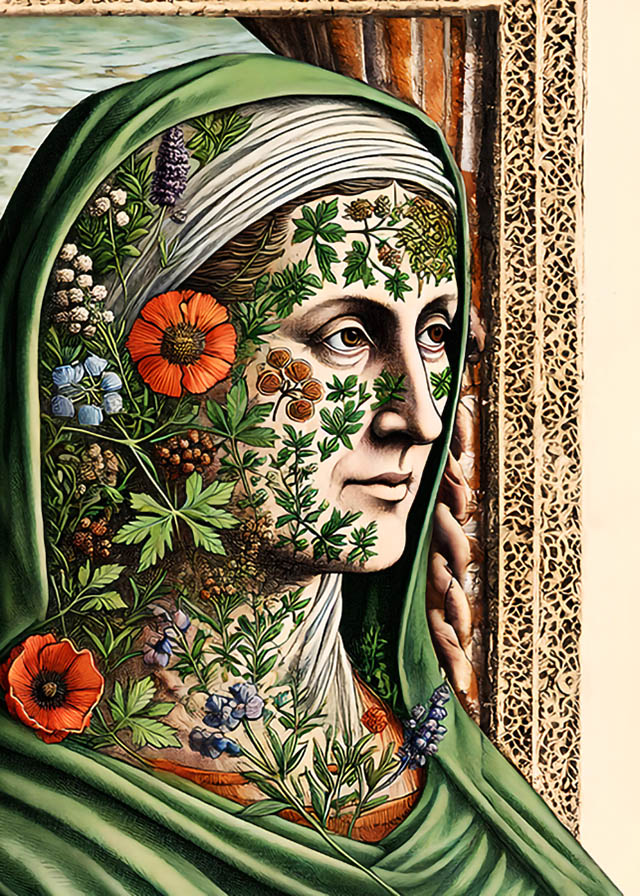
Trotula of Salerno (Italy, 1050. Date of death unknown)
Salerno was one of the most important ports in southern Europe, famous for its hot springs and its scientific exchanges with the East. The Salerno Medical School, founded in the 9th century, was open to women, making it the birthplace of gynecology. One of the greatest names in this science was Trotta di Ruggiero, known as the Trotula of Salerno. Her work on childbirth, menstrual cramps and breast pain resulted in the pioneering On Women's Diseases, a compendium of herbal remedies. Trótula's relevance goes beyond scientific pioneering, and also involves her understanding of the difficulties women had in expressing intimate problems in a highly masculinist world. For centuries, her work was attributed to men. Kaspar Wolf, a Renaissance publisher, for example, credited it to a Roman freed slave, Eros Juliae. The concealment of women's work was (and still is) a strategy for silencing their intellectual production and social and political marginalization. To this day, the authorship of Trótula's work is debated, under the hypothesis that she never existed and that the book is a collection of women authors. This hypothesis, far from disqualifying her, celebrates her: there are many of us, and we are all Trótula of Salerno.
References:
Deplange, Luciana, and Karine Simioni, eds. On Women's Diseases / Trotula Di Ruggiero. Florianópolis: UFSC/DLLE/PGET, 2018.
Moura, Willian Henrique Cândido, and Virginia Castro Boggio. "Translation as payment of a historical debt: Trotula di Ruggiero, medieval researcher and physician." Revista Estudos Feministas 29 (June 30, 2021): e72289. https://doi.org/10.1590/1806-9584-2021v29n272289.
"Trotula of Salerno." In Wikipedia, the free encyclopedia, October 29, 2021. https://pt.wikipedia.org/w/index.php?title=Trotula_de_Salerno&oldid=62331903.