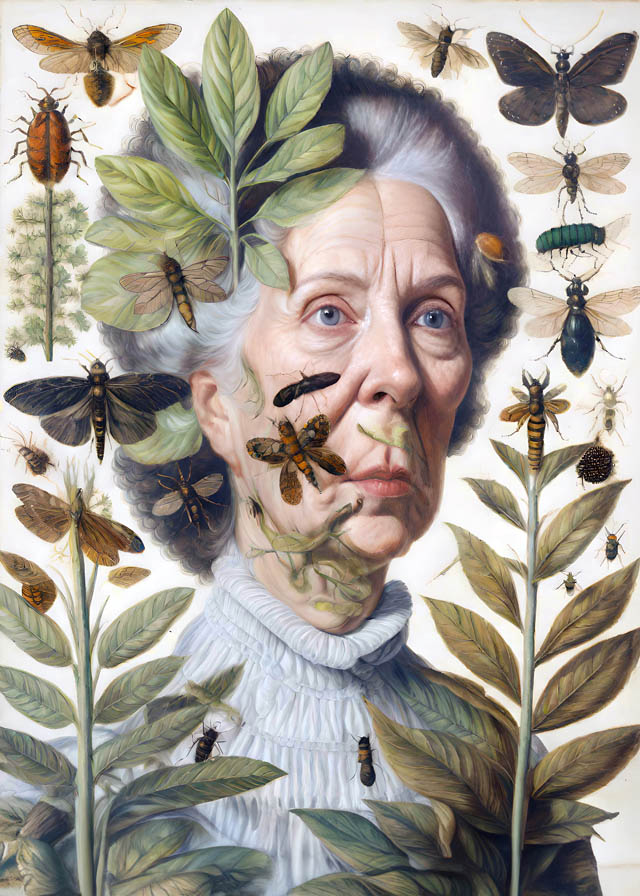
Maria Sybilla Merrian (Germany, 1647 - Netherlands, 1717)
Maria Sibylla Merian was a naturalist and scientific illustrator from a time when few women could participate in science. At the age of 52, she embarked on a scientific expedition to Suriname in South America in 1699, accompanied only by her daughter. She financed the trip by selling her engravings. Before that, she had already abandoned her oppressive husband, with whom she lived in a celibate community in Holland. In 1705, facing financial difficulties due to the costs of the trip, she published Metamorphosis Insectorum Surinamensium, an illustrated book about the insects of Suriname. In 1715, she suffered a stroke that left her partially paralyzed and two years later she died in Amsterdam, impoverished and with weakened eyesight. Her works were criticized in the 19th century by misogynistic scientists, who disdained her metaphorical descriptions. Over time, she was rediscovered by feminist researchers and her artistic value also grew. In 2011, an edition of her Neues Blumenbuch sold for £570,000 at Christie's auction. His illustrations and discoveries helped revolutionize the understanding of ecological interactions between plants and insects, as well as documenting the transformation of caterpillars into butterflies. Honestly, it's hard to imagine that a man of his time could pioneer a field of study such as metamorphosis.
References:
Mariath, Fernanda, and Leopoldo C. Baratto. "Female Naturalists and the Patterns of Suppression of Women Scientists in History: The Example of Maria Sibylla Merian and Her Contributions about Useful Plants." Journal of Ethnobiology and Ethnomedicine 19, no. 1 (May 12, 2023): 17. https://doi.org/10.1186/s13002-023-00589-1.