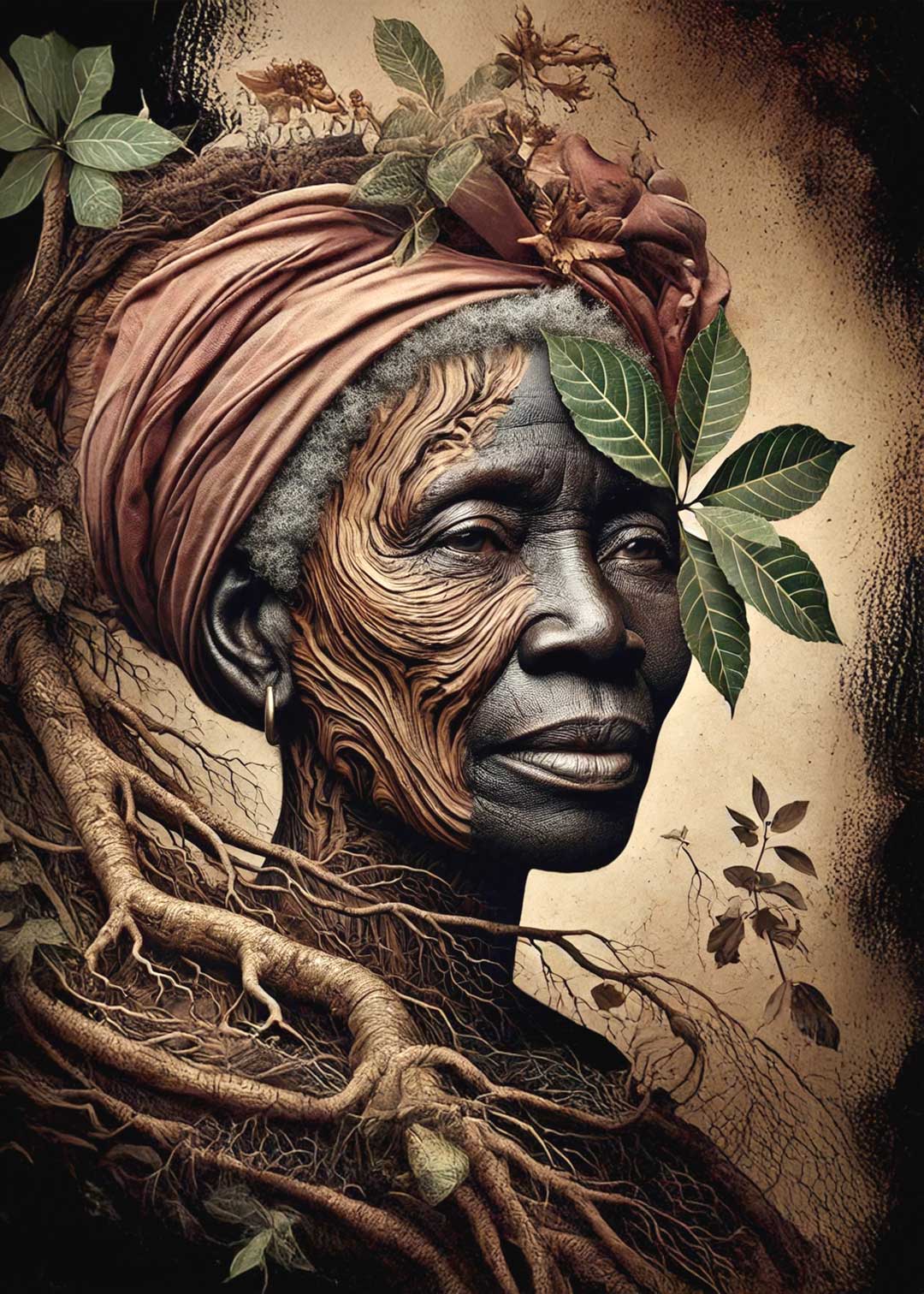
Luzia Pinta
(Angola ≈1700 - Portugal, date of death unknown)
Luzia Pinta was enslaved as a child and lived in Minas Gerais. She bought her freedom from her brothers João Pinto Dias and Manoel Pinto Dias, her masters, and a small plot of land in Sabará, where she lived. She took part in calundus, collective rituals of possession and trance, with divinatory and therapeutic functions, which have their origins in the religious practices of the ambundas and bacongas societies.
In these ceremonies, which became widespread in Brazil between the 17th and 18th centuries, only a few people, because they were spiritually prepared, like Luzia, connected with the spirits of the ancestors to receive their energies. In the ancient kingdom of Congo, these people were called xinguilas. Luzia was one of them and had the gift of healing both soul and body. She smelled the sick to diagnose their ailments and made remedies with flour and the roots of pau-santo and abatua. Denounced to the Inquisition for practicing "diabolical rituals" in 1739, she was sent to Lisbon, tried by the Tribunal of the Holy Office and imprisoned in 1742. She died in exile without it being known how or when.
In order to create her portrait, I had to negotiate a lot with the AIs, who not only find it difficult to represent black and older women, but also struggle with themes such as torture and slavery. I wanted Luzia to be haughty, like the other women in this exhibition, but also to bear the marks of the pain and suffering imposed on her. It took me months to come up with an image that would pay homage to her, dignifying in her figure all the witch doctors murdered by the Inquisition.
Portrait of Luzia Pinta, aged 40, created with artificial intelligence, based on information collected in texts by Alexandre Almeida Maccusi, Laura de Mello e Souza, Luiz Mott, Mary del Priore and an imaginary portrait of Luzia Pinta by Guignard. 2025.
References:
Luzia Pinta (século XVIII). Biografias de Mulheres Africanas, 2 jul. 2020. Disponível em: <https://www.ufrgs.br/africanas/luzia-pinta-seculo-xviii/>.
MARCUSSI, A. A. Captivity and healing: religious experiences of Atlantic slavery in the calundus of Luzia Pinta, 17th-18th centuries. Doctoral thesis. University of São Paulo, Aug. 7, 2015.
MOTT, L. Angola's sorcerers in the Portuguese Inquisition. Mneme - Revista de Humanidades, v. 12, n. 29, 5 aug. 2011.
PRIORE, M. DEL. Survivors and warriors: A brief history of women in Brazil from 1500 to 2000. São Paulo, SP: Planeta, 2020.
SANTOS, L. V. D. "TERRA INFICCIONADA": INDIGENOUS MAGICAL-RELIGIOUS PRACTICES AND THE INQUISITION IN EIGHTEENTH-CENTURY PORTUGUESE AMAZON. Master's dissertation. Federal University of São João Del-Rei. 2016.
SOUZA, L. DE M. E. O diabo e a terra de santa cruz. São Paulo: Companhia das Letras, 1986.
SURIS, A. Curandeiras e bruxas: práticas de feitiçaria e a subversão da ordem social no estado do Grão-Pará (1763-1769). Master's dissertation. Unisinos. 18 Apr. 2024.